


Archaeology sheds new light on Suleyman the Magnificent's final campaign in Hungary
Research shows Ottoman settlement surrounding sultan's tomb near Szigetvar was larger and wealthier than previously thought
Archaeological research near Szigetvar Castle in Hungary, where Ottoman Sultan Suleyman the Magnificent led his final military campaign, has revealed that the settlement established around his presumed place of death was considerably larger than previously thought.
The findings have provided new insights into the size, structure and daily life of the Ottoman settlement known as Turbek, which developed around a tomb built in Suleyman's honor.
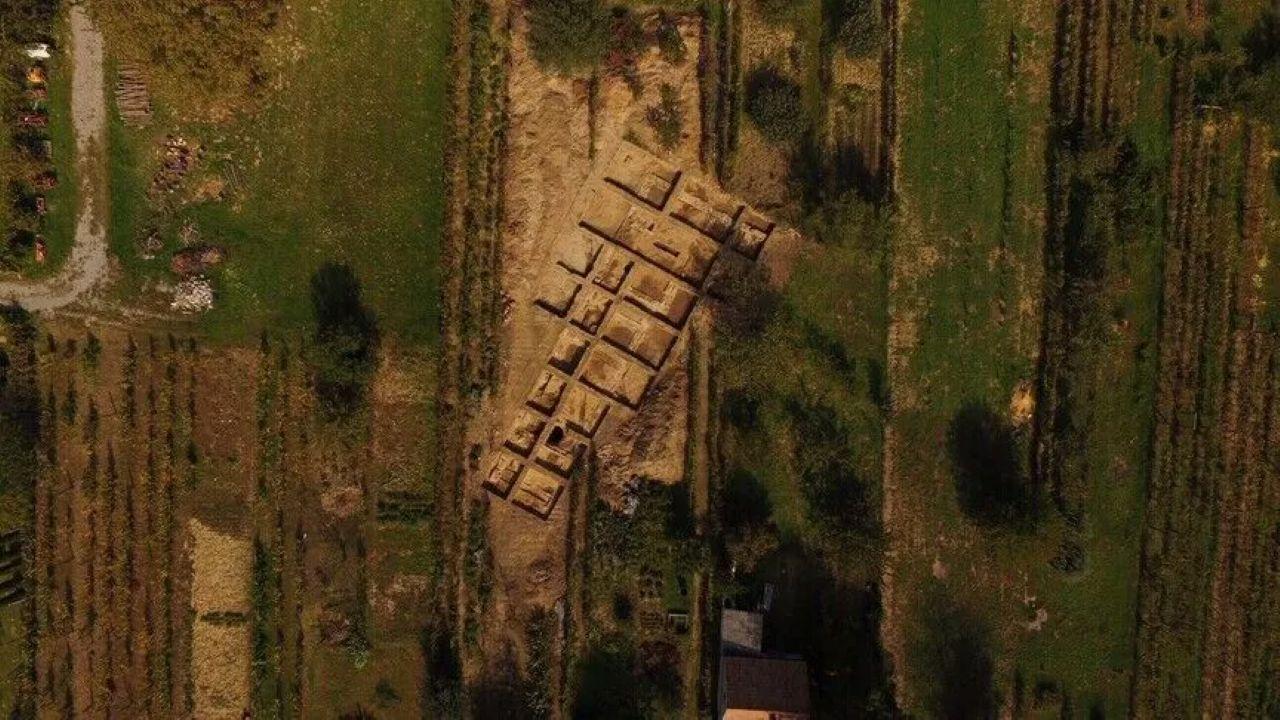
Research conducted by Hungary's University of Pecs in 2024 and 2025 found Ottoman-era artifacts scattered across an area of approximately 80 hectares, with their concentration varying across different parts of the site.
The evidence indicates that the settlement was not only more extensive than earlier estimates suggested but also relatively prosperous.
The findings have drawn renewed attention to Suleyman's last campaign and the Ottoman remains near Szigetvar on the 460th anniversary of his death during the siege of the castle on the night of Sept. 6-7, 1566.
Suleyman's final campaign and death
Suleyman, the longest-reigning sultan in Ottoman history, who ruled for nearly 46 years, left Istanbul on May 1, 1566, to lead his 13th and final military campaign.
Despite his advanced age and declining health, he traveled at the head of the army. His imperial tent was erected on a hill overlooking Szigetvar Castle, at what is now believed to be the site of the tomb complex.
Suleyman died in his tent during the night of Sept. 6-7. The fortress fell to Ottoman forces shortly afterward.
Historical sources say the sultan's death was concealed from the army to prevent a breakdown in morale and discipline and to ensure the peaceful accession of his son, Selim II.
According to historical accounts, Suleyman's internal organs were removed to preserve his body, which was treated with amber and musk before being temporarily buried beneath the throne inside his tent.
Some historical sources and widely accepted accounts maintain that his internal organs were buried at the encampment.
His body was reportedly exhumed about 42 days later and placed in a carriage for the return journey, during which officials continued to act as if the sultan were alive. His death was formally announced after Selim II arrived in Belgrade.
Ottoman settlement developed around tomb
On Selim II's orders, a tomb was built at the site where Suleyman was believed to have died and where his internal organs were thought to have been buried.
As the tomb developed into an important pilgrimage site, a mosque, dervish lodge, guesthouse and guard barracks were constructed nearby.
The complex was protected by a wooden palisade and other defensive structures, while a civilian settlement gradually emerged around it.
Known as Turbek, the settlement was destroyed as Ottoman rule in the region ended. Its exact location was eventually forgotten after the buildings disappeared and the land was converted into vineyards and gardens.
Scientific research locates long-lost tomb
Modern efforts to locate Suleyman's tomb began after the Turkish Cooperation and Coordination Agency and the Municipality of Szigetvar signed an agreement in 2012.
An interdisciplinary team led by Professor Norbert Pap of the University of Pecs studied historical documents, maps and land records, as well as a plan of the tomb complex drawn in 1664.
The researchers concluded that the original tomb complex stood on Vineyard Hill in the Turbek-Zsibot area, about 4.2 kilometers northeast of Szigetvar Castle.
Excavations launched in 2015 uncovered a square building that researchers identified as the tomb constructed in Suleyman's honor.
Subsequent work revealed traces of a mosque, dervish lodge, guesthouse, guard barracks, wooden palisade and civilian buildings.
Discoveries offer glimpse of daily life
During the 2024-2025 research period, Turkish and Hungarian researchers led by the University of Pecs used modern surveying equipment to conduct surface studies and geophysical surveys across the wider area surrounding the tomb complex.
Everyday objects, ceramics, coins, jewelry and examples of Ottoman metalwork were discovered around buildings, some of which were constructed of brick and covered with roof tiles.
Archaeologists also uncovered a well and large storage pits containing traces of grain, terracotta pieces from heating systems, footed bowls, fragments of porcelain cups and pieces of painted glass vessels.
Other finds included a rare 16th-century gold coin, a silver coin from the Crimean Khanate, pieces of Ottoman tableware, rings, decorated buckles and horse-harness ornaments.
Researchers said the findings point to the existence of an extensive Ottoman settlement beyond the central tomb complex and suggest that some of its residents and visitors were affluent by the standards of the period.
- Popular News -
Has Noah's Ark been found? Here's what we know so far
2,500-year-old discovery at ancient city where Alexander the Great's soldiers settled
190-year-old church known for its wall paintings to open to visitors

WhatsApp introduces optional parental controls for teenagers
Is Turkish coffee healthy? A cardiologist explains the benefits and risks of coffee
Catacombs of Kom el Shoqafa: Hidden underground for centuries, discovered by chance